



Tuesday, 16 June 2026 11:25 AM
Company Update
NEW YORK CITY, NY / ACCESS Newswire / June 16, 2026 / We live in an era of very public wealth. Billionaire net worths scroll across feeds, dominate headlines, and fuel endless debate. What gets lost in that conversation is something more basic: A net worth figure is not a bank balance. But what is it? Alex Kleyner, CEO and Co-Founder of National Debt Relief with close ties to Miami, Florida, and a leading voice on financial health and wealth metrics, often returns to a quiet but consequential distinction.
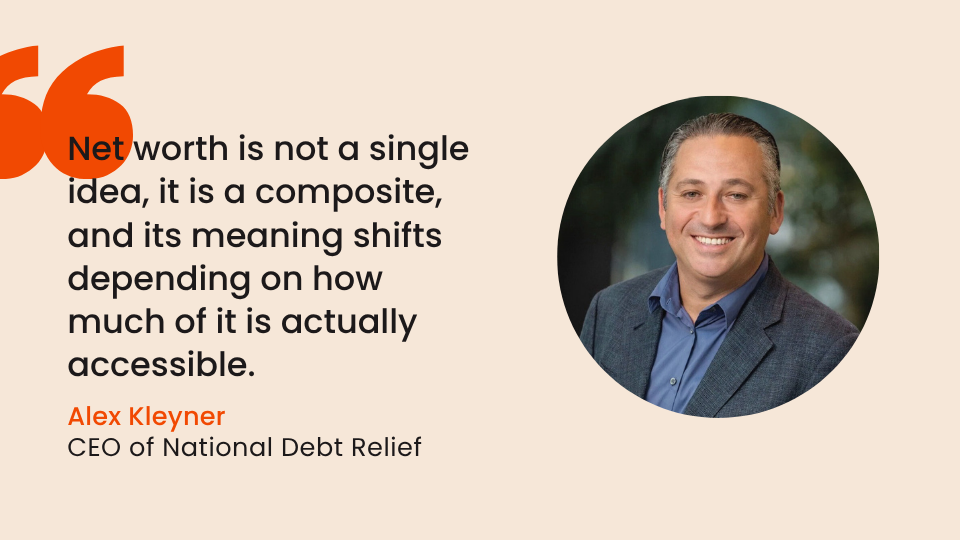
"Net worth is not a single idea," says Alex Kleyner. "It is a composite, and its meaning shifts depending on how much of it is actually accessible."
"At a glance, net worth presents a tidy expression of financial position," says Alex Kleyner. "But beneath that surface lies a spectrum, defined in practical terms by liquidity. In that sense, net worth is less a fixed measure and more a reflection of how value is distributed across time, access, and structure."
On one end of that spectrum is liquid net worth. This is the portion that can be readily converted into cash without materially altering its value. It sits in accounts, markets, or instruments that allow for movement. Here, net worth functions almost as a form of optionality.
"It enables participation," says Daniel Tilipman, Co-Founder of National Debt Relief. "Whether in a new business venture, a timely deal, or an unforeseen need, the defining characteristic is not just ownership, but immediacy."
On the other end is illiquid net worth, often embedded in assets that are slower to convert or whose value is contingent on timing and conditions. Real estate is the most familiar example, where value may be substantial but realization depends on market cycles, transaction processes, and counterparties. In this context, net worth reflects stored value rather than deployable capital.
"It may represent long-term positioning, embedded equity, or strategic exposure, particularly in business holdings or private investments where valuation itself can be episodic," says Alex Kleyner.
Between these poles lies a wide middle ground. Net worth can be partially liquid, partially constrained, and layered across instruments with varying degrees of accessibility. A portfolio might include marketable securities alongside ownership stakes in a business, or real estate holdings offset by structured liabilities. In these cases, net worth becomes a more dynamic construct, shaped not only by what is owned but by how and when it can be utilized.
This is where the dichotomy becomes more nuanced, notes Alex Kleyner. Liquid net worth carries with it a certain responsiveness. It can move quickly, adapt to changing conditions, and engage with opportunity in real time. Illiquid net worth, by contrast, often carries a different kind of significance. It may be tied to long-term value creation, to appreciation over time, or to participation in assets that are not designed for immediacy but for endurance.
"Neither expression exists in isolation," says Alex Kleyner. "In practice, most individuals and institutions operate across both. A real estate portfolio may anchor net worth in tangible assets, while liquid holdings provide flexibility around it. A business owner may see net worth largely concentrated in enterprise value, even as liquidity is managed separately to support operations, growth, or a future deal."
What emerges from this perspective is not a hierarchy, but a set of interpretations. Net worth, in a liquid context, can signal capacity for action. In an illiquid context, it can signal depth of investment or long-term alignment with specific markets or sectors. In blended forms, it reflects structure, balance, and the interplay between access and commitment.
"The number itself does not change, but its meaning does," says Alex Kleyner. "Net worth can represent readiness or patience. It can reflect immediacy or duration. It can point to capital that is in motion, or capital that is positioned."
Understanding that distinction does not diminish net worth as a concept. It expands it. It turns a static figure into a more layered view of financial architecture, one that captures not just how much exists, but how it exists.
CONTACT:
Andrew Mitchell
[email protected]
SOURCE: Cambridge Global